
Burn Your Belly Fat - Part 8
Belly Fat Burner #8: Eat Protein and Fiber at Every Meal
Protein
Protein is an important macronutrient for maintaining good health. It helps build and repair muscles, supports immunity, and even plays a role in weight management.
Protein is critical for our body. It is the building block that makes up your hair, bones, muscles, hormones, tendons and antibodies. It is so important that if you don’t receive enough protein through your diet, your body will break down lean tissue (sayonara muscle!) and use it for these other important bodily functions. That is why we must continually replace protein and consume enough of it in our diet.
Proteins are made of amino acids. Our body manufactures some of the amino acids, but it relies on our diet to obtain the 9 amino acids that our body cannot make on its own. The amino acid profile is what makes protein either complete, or incomplete.
What Is the Difference Between Complete and Incomplete Proteins?
Complete proteins contain the 9 amino acids that the body cannot make on its own. Incomplete proteins, as you may have guessed by the name, do not have the full spectrum of amino acids.
Animal proteins like meat, eggs and dairy are examples of complete proteins. On the other hand, most vegetable proteins, with the exception of soy, are incomplete. You can get complete proteins from vegetarian food sources by combining a variety of selections, like rice and beans.
Does Protein Curb Your Appetite?
Yes. Protein’s ability to delay hunger can help reduce temptations to snack outside of your usual eating routine. But how does protein actually keep you feeling full? Your body communicates how full it is to your brain through mu-pioid receptors (MORs) which are nerves lining the walls of the blood vessels that drain blood from your digestive system.
When the MORs are blocked, that tells your brain to limit food intake, and brings about the “full” feeling you get. Peptides, the byproduct of digested proteins, blocks MORs and curbs your appetite. [50]
There are many protein supplements and powders out there, but many continue to come under much scrutiny lately. Consumer Reports revealed that many popular whey protein brands are contaminated with heavy metals. [51] Not only that, but they contain many additives and unhealthy ingredients.
Even still, protein powder is a convenient way to consume high-quality, complete protein while suppressing your appetite and giving you an energy boost. Just make sure to do your homework before you buy one. Aim for a product that has around 15 to 30 grams per serving.
Before You Use Whey Protein, Consider This Whey Protein Alternative
I have tried so many types of protein- whey protein, soy protein, whey isolate, pea protein, plant based proteins (blend of flax, chia, pumpkin, quinoa).
After careful research over the years and wasting a lot of money in the process, I have switched entirely over to hemp seed protein. I like whey protein is quickly digested, has a high amino acid profile, and is easily absorbed by the body.
I believe that plant-based options are healthier, however there are several problems I have with some of the other plant based options.
First, is you have to make sure that the blend of protein sources give you a complete protein source.
Second is they have quinoa, peas and other lectin-containing ingredients. We’ll cover lectins in Belly Fat Burner #13.
I have ditched protein bars and whey protein powder altogether and I recommend you to do the same. Most of these healthy shakes and bars are marketed as a healthy option for busy people, but in fact it’s just as bad as a candy bar.
Do your research before you car out a 36-pack case at Costco because the deal was too good to pass up. Believe me, I’ve made this mistake before.
So What Type of Protein Should You Take?
I highly recommend taking Hemp Seed Protein powder. It is easy to digest and for your body to use.
Do You Need to Buy Protein Powder?
No, you do not need to add protein powder to your diet if you’re able to obtain enough protein from food. First, calculate how much protein you’re eating and drinking. If you need more protein, consider making your own protein shakes.
Timing of Protein
The timing of when you take protein is important. Eating protein immediately after you exercise (both endurance and resistance-training exercises) helps to repair and synthesize muscle proteins. [52]
A study published in the American Journal of Clinical Nutrition, showed 20 grams as the best amount of post-workout protein to maximize muscle growth. [53] A different study showed that only the first 30 grams of dietary protein actually go towards building muscle. [54]
When you have more protein than your muscles need, your body will break the protein down and use some for energy and excrete whatever it doesn’t need.
Here’s a big caution that I cannot emphasize enough; do not overload on protein.
You don’t need a lot of it for your body to perform at an optimal level. You can end up with an irritated stomach, kidney problems, and excess protein can leach calcium from your bones.
Somewhere in between the 20 to 30 gram range of protein is best right after working out and during a meal.
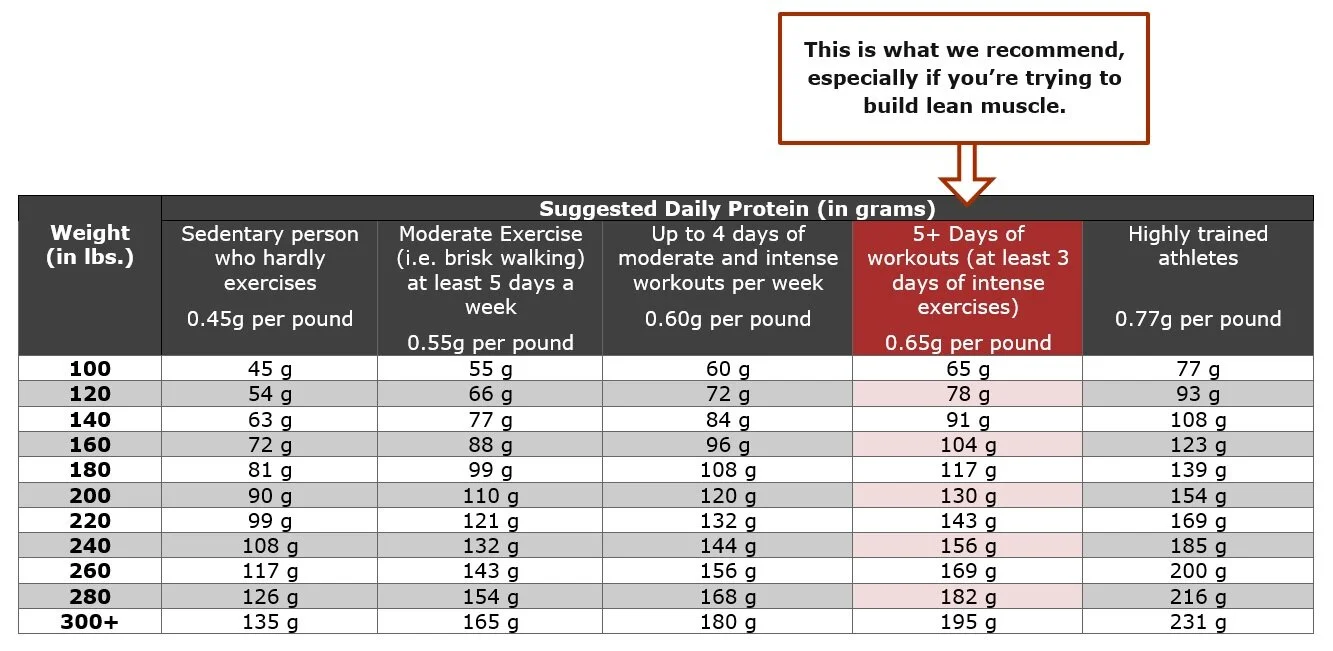
How Much Protein Do You Need?
I couldn’t believe how confused I was researching the answer to this question. There are so many articles with varying opinions. To cut through the clutter and confusion, I have come up with the amount of protein your muscles need to be in optimal condition.
* PLEASE NOTE: Portions of the figures in the protein table are based on a combination of information. [49, 55, 56] The protein intake next to weight indicates the maximum amount of protein intake for that category. Talk to your doctor before following any recommended protein consumption, especially if you have kidney disease, osteoporosis, diabetes or liver disease. [57] Although important in a diet, extra protein will not help you build more muscle or make you stronger. Stick to these guidelines to make sure you’re getting enough (but not too much) protein.
What Foods Are High in Protein?
The following foods are high in protein:
Fruits
Avocado (2g per half)
Dates (3. 5g per cup)
Mangos (2. 8g, medium fruit)
Prunes (3. 8g per cup, pitted)
Raspberries (8g per cup)
Vegetables
Artichokes (4g, medium size)
Broccoli (4g per cup, boiled)
Brussel Sprouts (3g per cup)
Peas (9g per cup, cooked)
Legumes
Black beans (42g per cup)
Black-eyed peas (4g per cup)
Kidney beans (15g per cup)
Lentils (18g per cup)
Lima beans (15g per cup, boiled)
Navy beans (6g per cup)
Pinto beans (41g per cup)
Split peas (48g per cup)
White beans (47g per cup)
Nuts & Seeds
Almonds (6g per 1 ounce, 23 pieces)
Cashews (5g per 1 ounce)
Flaxseed (2g per 1 tbsp.)
Hazelnuts (6g per 1 ounce)
Peanuts (7g per 1 ounce)
Pecans (2. 5g per 1 ounce)
Pistachios (6g per 1 ounce)
Pumpkin Seeds (5g per 1 ounce)
Sunflower seeds (10g per 1 ounce)
Walnuts (4g per 1 ounce)
Dairy Cheese (5g per slice)
Eggs (6g per large egg)
Milk (8g per 8 ounces)
Yogurt (10g per 8 ounces)
Soy Products
Edamame (8g per half cup)
Tempeh (15. 5g per half cup)
Tofu (10g per 1 ounce)
Seafood
Catfish (16g per fillet)
Clams (24. 5g, 10 small-sized clams)
Cod (41g per fillet)
Crab (24g per cup)
Crayfish (45g per 3 ounce)
Flounder (20g per fillet)
Haddock (30g per fillet)
Halibut (36g per half fillet)
Herring (44g per 100 grams)
Lobster (28g per cup)
Mussels (20g per 3 ounces)
Octopus (25g per 3 ounce)
Oyster (8g per 6 medium-sized oysters)
Salmon (40g per half fillet)
Scallops (17g per 3 ounce)
Sea Bass (24g per fillet)
Squid (15g per 3 ounce)
Trout (17g per fillet)
Tuna (25g per 3 ounce)
Poultry
Beef (22g per 3 ounce)
Chicken (35g per cup)
Duck (27g per 3 ounce)
Ham (29g per cup)
Lamb (21g per 3 ounce)
Pork (19g per 3 ounce)
Rabbit (28g per 3 ounce)
Turkey (25g per 3 ounce)
Veal (21g per 3 ounce)
Venison (22g per 3 ounce)
BOOST THE CALORIES YOU BURN
Thermogenic response, or thermic effect of food (TEF), is the number of calories required to digest, absorb, store and transport food.
That’s right!
Your body burns calories by moving and using food in your body without you lifting a finger. Protein is the most thermogenic macronutrient. Its thermic effect is about 30%. [58] Protein is harder to digest than carbohydrates and fats, which respectively have a thermogenic response of 7% and 3%.
PART 2: FIBER
Fiber is great to help you lose weight and even more importantly maintain that weight loss. Foods that are high in fiber take more time for your body to digest, and therefore there’s a steady stream of energy provided by fibrous food. This helps increase your energy level during the day and prevents those cravings from creeping back.
Fiber is unique in the sense that it helps you feel full for a long time without adding calories. Since most dietary fiber is undigested by our body and cannot be converted to glucose, it has no calories.
Alarmingly, 90% of us are not eating enough fiber.
Women on average are getting about 14 grams of fiber, when they should really get 25 grams per day. Men should be getting 35 grams per day.
You may think consuming enough fiber in your diet is trivial, but it is far from it.
Fiber clears food, bile and toxins from your intestines.
Women who eat a fiber-rich diet have up to a 59% lower death rate from heart, lung, cancer, and infectious diseases than those don’t eat the recommended amount. Likewise, men had up to a 56% lower risk of dying from the aforementioned diseases. [59]
The following foods are high in fiber:
Fruits
Apple (4g, medium size)
Avocado (9g, half of fruit)
Banana (3g, medium size)
Blackberries (8g per cup)
Blueberries (4g per cup)
Boysenberries (7g per cup)
Elderberries (10g per cup)
Figs (8g per half cup)
Orange (4g, medium size)
Peaches (2g per 2 ounces)
Pear (6g, medium size)
Prunes (6g per half cup)
Raspberries (8g per cup)
Strawberries (3g per cup)
Vegetables
Artichoke (7g, medium size)
Asparagus (3g per cup, raw)
Beet Greens (4g per cup)
Broccoli (6g per cup, cooked)
Brussels Sprouts (3g per cup, raw)
Cauliflower (4g per cup)
Celery (1g, medium stalk)
Collard Greens (5g per cup, cooked)
Kale (3g per cup, cooked)
Peas, green (6g per cup, frozen) Peas, green, frozen (14g per cup)
Spinach (4g per cup, cooked)
Sweet Potato, with skin (4g, medium size)
Swiss Chard (4g per cup)
Legumes
Adzuki beans (17g per cup, cooked)
Black beans (15g per cup, cooked)
Cashews (1g per ounce)
Edamame (8g per cup)
Flaxseed (8g per ounce)
Garbanzo beans (12g per cup, cooked)
Hazelnuts (3g per ounce)
Kidney Beans (16g per cup, cooked)
Lentils (16g per cup, cooked)
Lima Beans (14g per cup, cooked)
Navy Beans (19g per cup, cooked)
White Beans (19g per cup, cooked)
Nuts & Seeds Almonds (4g per ounce)
Peanuts (2g per ounce)
Pecans (3g per ounce)
Pistachios (3g per ounce)
Pumpkin Seeds (3g per half cup)
Sunflower seeds (3g per quarter cup)
Walnuts (2g per ounce)
